Walking into a modern data center feels less like stepping into a server room and more like entering the nervous system of a digital organism. Rows of machines hum in quiet unison, feeding models that detect anomalies in radiology scans, optimize delivery routes, or generate responses in real time. Behind all that activity, a shift has been unfolding—not just in how we process information, but in who’s building the tools to make it possible. At the center of this shift is an alliance that doesn’t make headlines like some of the flashier duos in tech, but whose impact runs deep: the collaboration shaping up between AMD and Microsoft in artificial intelligence.
The Foundation Is Changing
AI isn’t just about algorithms anymore. The performance ceiling in machine learning has increasingly become a hardware problem. Training large models demands massive parallel computation, memory bandwidth that doesn’t buckle under pressure, and energy efficiency that keeps costs from spiraling. This is where the traditional boundaries between CPUs, GPUs, and adaptive computing hardware start to blur. For years, NVIDIA dominated with its CUDA ecosystem, locking developers into a tightly coupled stack of silicon and software. But that duopoly wasn’t inevitable—it was circumstantial. And now, with AMD and Microsoft AI building momentum together, the rules are being rewritten.
AMD’s approach has always leaned on openness and flexibility. While others bet on proprietary lock-in, AMD doubled down on a broader AI ecosystem—one not limited to one type of workload or one vendor’s stack. That doesn’t mean they’re starting from scratch. The AMD Instinct line of accelerators, for example, has been gaining traction in high-performance computing circles for years. These GPUs aren’t just raw horsepower; they’re designed with features like high-bandwidth memory (HBM) and fine-grained parallelism that align well with the demands of training and AI inference. What’s different now is who’s adopting them—and why.
Why Microsoft Azure Is Betting on AMD
If you're running AI at scale, you're likely using Microsoft Azure. It’s one of the top three cloud computing platforms globally, and its influence on enterprise AI adoption is hard to overstate. For Azure to onboard new hardware at scale, it needs more than specs on a datasheet. It demands compatibility, support, and a software path that lets developers hit the ground running. That’s where the alignment between AMD and Microsoft becomes strategic, not just transactional.
Microsoft hasn't just added AMD hardware as an option—it’s integrated it into the core of its AI development stack. PyTorch, the most widely used machine learning framework in research and increasingly in production, now runs efficiently on AMD Instinct accelerators through the ROCm software platform. This was a hard-won milestone. Early versions of ROCm faced criticism for being fragmented and difficult to deploy. But steady investment, particularly from AMD’s software teams in collaboration with Microsoft engineers, has turned ROCm into a credible alternative to CUDA. It’s not just about compatibility. It’s about delivering performance that competes, with a license model that doesn’t trap customers.
The integration goes deeper. DirectML, Microsoft’s low-level API for machine learning on Windows and Azure, now supports AMD GPUs natively. That means models developed locally on a Radeon AI-enabled workstation can be seamlessly scaled in Azure using the same underlying execution path. No rewrites. No retraining. The continuity matters—especially for companies building internal tools or vertical AI applications where deployment speed is as critical as model accuracy.
The Architecture Behind the Momentum
AMD’s recent processor designs reflect a clear understanding of where compute is headed. The Zen 5 architecture, which forms the backbone of its latest CPUs, isn’t just about faster clock speeds. It introduces deeper branch prediction, improved floating-point throughput, and better integration with accelerators—all subtle changes that compound when you're running distributed training jobs across hundreds of nodes.
But the real story isn’t just in the CPU. It’s in how AMD is treating computation as a spectrum. On one end, you have adaptive computing—FPGAs and other reconfigurable silicon like the Alveo accelerators—ideal for workloads where latency is non-negotiable. Think real-time fraud detection in financial transactions or adaptive compression in live video streaming. On the other end, you have GPUs that rival the best in class on raw throughput for training large language models. In between sits a fleet of CPUs optimized not for standalone performance, but for feeding data efficiently to accelerators. It’s a holistic view of data centers as systems, not collections of components.

For Microsoft, this tiered approach is attractive. Not every AI task needs a full GPU rig. Some inference workloads run more efficiently on specialized adaptive computing hardware. Others benefit from the parallelism of a GPU but don’t justify the cost of a full training-grade card. By offering this range, AMD gives Azure the flexibility to tier its offerings—from cost-optimized instances for startups to bare-metal configurations for enterprises running confidential AI workloads.
The Software Matters as Much as the Silicon
Hardware without software is inert. And historically, that’s been AMD’s challenge in AI—the hardware may compete, but the tools lagged. The partnership with Microsoft has helped close that gap. Take DirectML again. It’s not flashy, but it’s pragmatic. Instead of asking developers to learn a new framework, it works within the existing DirectX ecosystem—something Microsoft has spent decades refining. That makes deployment on Windows machines, from edge devices to cloud virtual machines, almost invisible.
And beyond DirectML, the coordination extends into the developer experience. VS Code, Microsoft’s widely used code editor, now includes extensions that auto-detect AMD hardware and suggest ROCm-based runtimes. Azure Machine Learning, their managed service for training and deployment, supports AMD Instinct accelerators with pre-configured environments. These might seem like small touches, but they reduce friction—the kind of friction that, in aggregate, can determine whether a technology gets adopted or abandoned.
What’s especially notable is the shared commitment to open standards. While some AI hardware vendors rely on proprietary kernels to lock in performance advantages, AMD and Microsoft have backed Open Neural Network Exchange (ONNX) and other open formats. This means a model trained in PyTorch on AMD hardware in Azure can be exported and run on a variety of targets, including edge devices with Radeon AI. That portability is crucial for enterprises that need to maintain control over their stack and avoid being pinned to a single vendor’s roadmap.
Lisa Su and Satya Nadella: Architects of Alignment
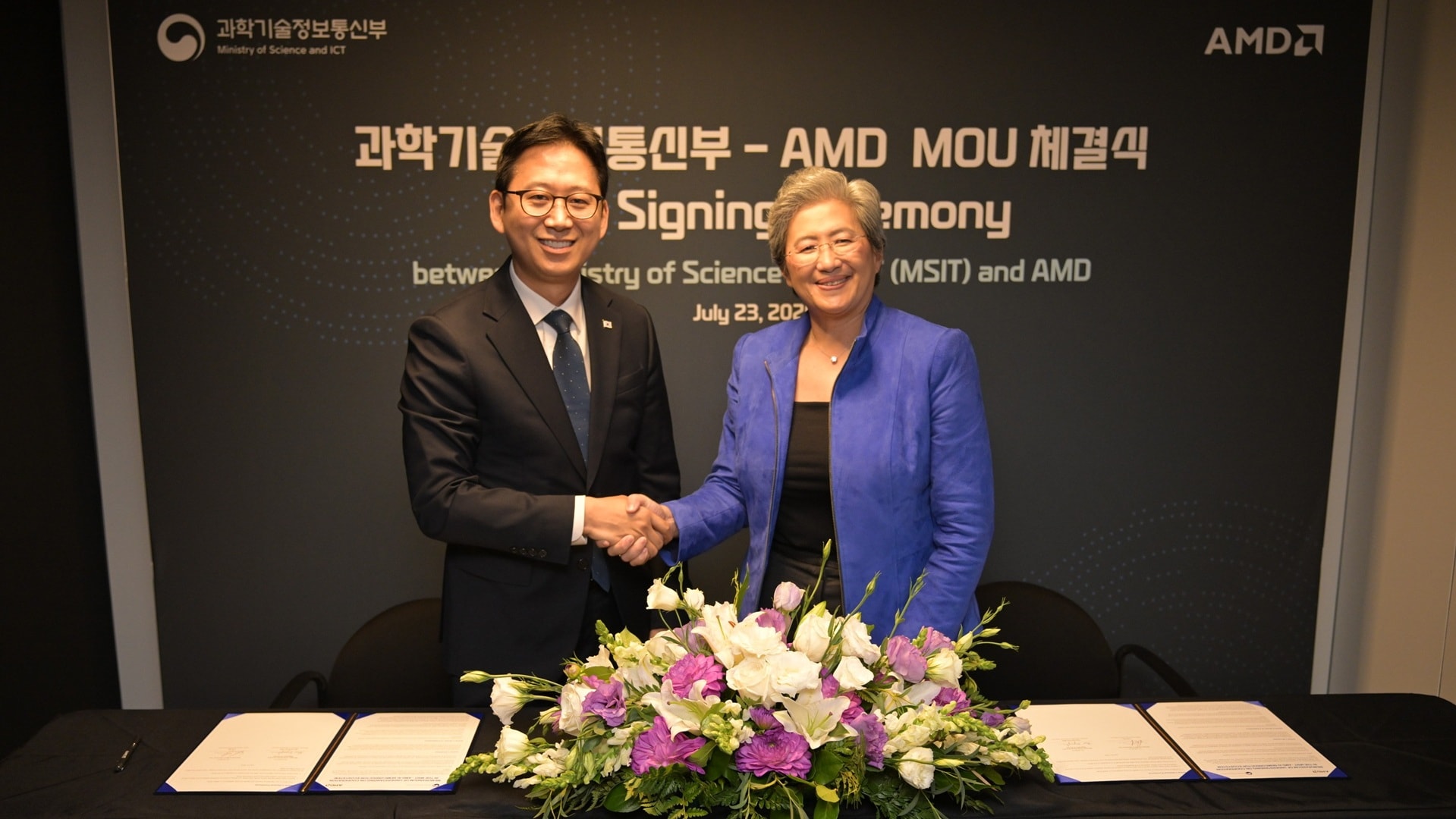
Behind every successful partnership are leaders who see further than their immediate products. Lisa Su and Satya Nadella aren’t just CEOs; they’re technologists who understand that the next phase of computing isn’t about who has the fastest chip, but who can deliver the most cohesive system. Their public appearances together are rare, but telling—joint keynotes at events like Microsoft Ignite or private meetings with enterprise clients suggest a level of coordination that goes beyond standard vendor contracts.
Su’s background in electrical engineering and semiconductor physics gives her a granular grasp of the trade-offs in chip design. She knows that power efficiency isn’t just a spec—it’s what determines rack density, cooling costs, and ultimately, profitability for cloud operators. Nadella, meanwhile, has spent years shifting Microsoft from a software licensing model to a cloud-first, AI-infused platform strategy. He understands that Azure’s success hinges on offering best-in-class performance across workloads, not just in isolated benchmarks.
Their alignment shows in decisions like the deployment of AMD-powered VMs in Azure for AI inference. These instances aren’t niche offerings; they’re positioned as cost-effective alternatives to GPU-heavy configurations, especially for workloads that benefit from high core counts and memory bandwidth—like batch processing of medical images or real-time recommendation engines. And because they’re built on mainstream x86 architecture, they integrate smoothly with existing Azure services like Kubernetes and Active Directory.

Where the Edge Meets the Cloud
Most AI coverage focuses on data centers, but a quiet revolution is happening at the edge. Devices—from retail kiosks to factory robots—are embedding AI capabilities directly, reducing latency and improving privacy. Here, AMD’s Radeon AI features have started to make a difference. Unlike discrete GPUs, Radeon AI is often integrated into APUs (accelerated processing units), combining CPU and GPU on a single die. These chips don’t train models, but they run inference efficiently, especially when paired with optimized libraries.
Microsoft’s Windows ML stack works hand-in-hand with this. A developer building a vision model for defect detection on a manufacturing line can use ONNX to export a model trained in Azure, then deploy it to a factory floor machine running Windows 11 with an AMD APU. The inference happens locally, eliminating round-trip delays to the cloud. For companies dealing with sensitive data—say, in healthcare or defense—this local processing isn’t just convenient; it’s a compliance requirement.
What’s emerging is a full-stack AI strategy: models trained on AMD Instinct accelerators in Microsoft Azure, optimized with PyTorch and ROCm, then deployed either back into the cloud for scalable inference or down to the edge using DirectML and Radeon AI. It’s not a single product. It’s a pipeline.
The Economics of Choice
Let’s talk numbers. A standard NVIDIA A100 GPU can cost upwards of $10,000 per unit, and data centers often deploy them in multiples of eight. Multiply that by dozens of racks, and you’re looking at tens of millions in hardware before you even turn the lights on. AMD’s MI300 series, which competes in the same segment, offers comparable performance at a lower price point. But cost isn’t just about sticker price—it’s about total cost of ownership.
- Power efficiency: AMD’s chips often deliver better performance per watt, reducing cooling demands.
- Memory bandwidth: High-bandwidth memory configurations lower data bottlenecks, improving throughput.
- Software maintenance: Open tools like ROCm reduce long-term licensing risks.
- Deployment velocity: Integration with Azure reduces setup time and configuration errors.
- Scalability: Hybrid deployments from cloud to edge reduce dependency on constant connectivity.
These factors compound. A 15% gain in energy efficiency across a thousand-node cluster can translate into millions saved annually. And while no one is claiming AMD is outperforming the competition in every workload, the gap has narrowed to the point where procurement decisions are no longer automatic. Enterprises are now running bake-offs—testing AMD and NVIDIA side by side—and in many cases, choosing AMD not because it’s faster, but because it’s sustainable, available, and integrated.
Challenges and Realities
None of this means the road has been smooth. ROCm, for all its progress, still has rough edges. Some third-party libraries that work out of the box with CUDA require manual patching or don’t work at all on AMD hardware. Docker images, Helm charts, and Kubernetes operators are still more mature for NVIDIA’s stack. Developers who’ve spent years with CUDA aren't eager to relearn tools, especially under deadline pressure.
There’s also the availability question. During the height of the AI boom, NVIDIA’s lead in supply chain and manufacturing gave it a massive edge. AMD has been playing catch-up—not in design, but in production volume. While the MI300X is a formidable chip, getting enough units into Azure data centers to meet demand has been a challenge. But that gap, too, is closing. TSMC’s 5nm and 4nm process nodes are now better utilized, and AMD’s partnership with major OEMs like Dell and HPE means its accelerators are showing up in on-premises deployments as well.
And let’s be clear: this isn’t about displacing NVIDIA. It’s about creating viable alternatives. In mature markets, monopolies tend to raise prices and slow innovation. A strong competitor doesn’t just benefit customers—it keeps the entire ecosystem honest.
The Next Wave: Co-Design and Collaboration
What comes next? Both companies are moving beyond simple integration toward co-design. There are indications that future AMD Instinct accelerators are being optimized specifically for Azure’s workload patterns—not just general matrix multiplication, but sparse operations, quantization, and mixed-precision training. Similarly, Microsoft is tailoring its AI services to take advantage of AMD’s unified memory architecture, where CPU and GPU share a common memory space, reducing data movement overhead.
We’re also seeing signals that adaptive computing could play a larger role. Alveo accelerators, while less known than Instinct, offer reprogrammable logic that’s ideal for custom AI pipelines. Imagine a network security model that adapts its filtering rules in real time, reconfiguring the FPGA fabric on the fly. That’s the kind of flexibility that, once you have it, is hard to give up.
Looking Beyond the Hype
The noise around AI often centers on model size: who has the most parameters, who trained the fastest, who’s building the biggest compute cluster. But real progress—the kind that makes AI usable in hospitals, factories, and schools—relies on reliability, accessibility, and sustainability. AMD and Microsoft aren’t chasing headlines with billion-dollar chips. They’re building an AI ecosystem that works for more people, in more places, without demanding a blank check.
The collaboration between them isn’t loud. You won’t see flashy joint events or viral press releases. But in data centers, in developer logs, and in enterprise procurement sheets, the impact is growing. This isn’t about one company beating another. It’s about creating infrastructure that scales without breaking—technologically, economically, and ethically.
The future of AI won’t be dictated by a single breakthrough or a solitary genius. It will be shaped by the quiet alignment of silicon and software, of hardware engineers and cloud architects, slowly building systems that last. And right now, one of the most important partnerships making that possible is unfolding between AMD and Microsoft.